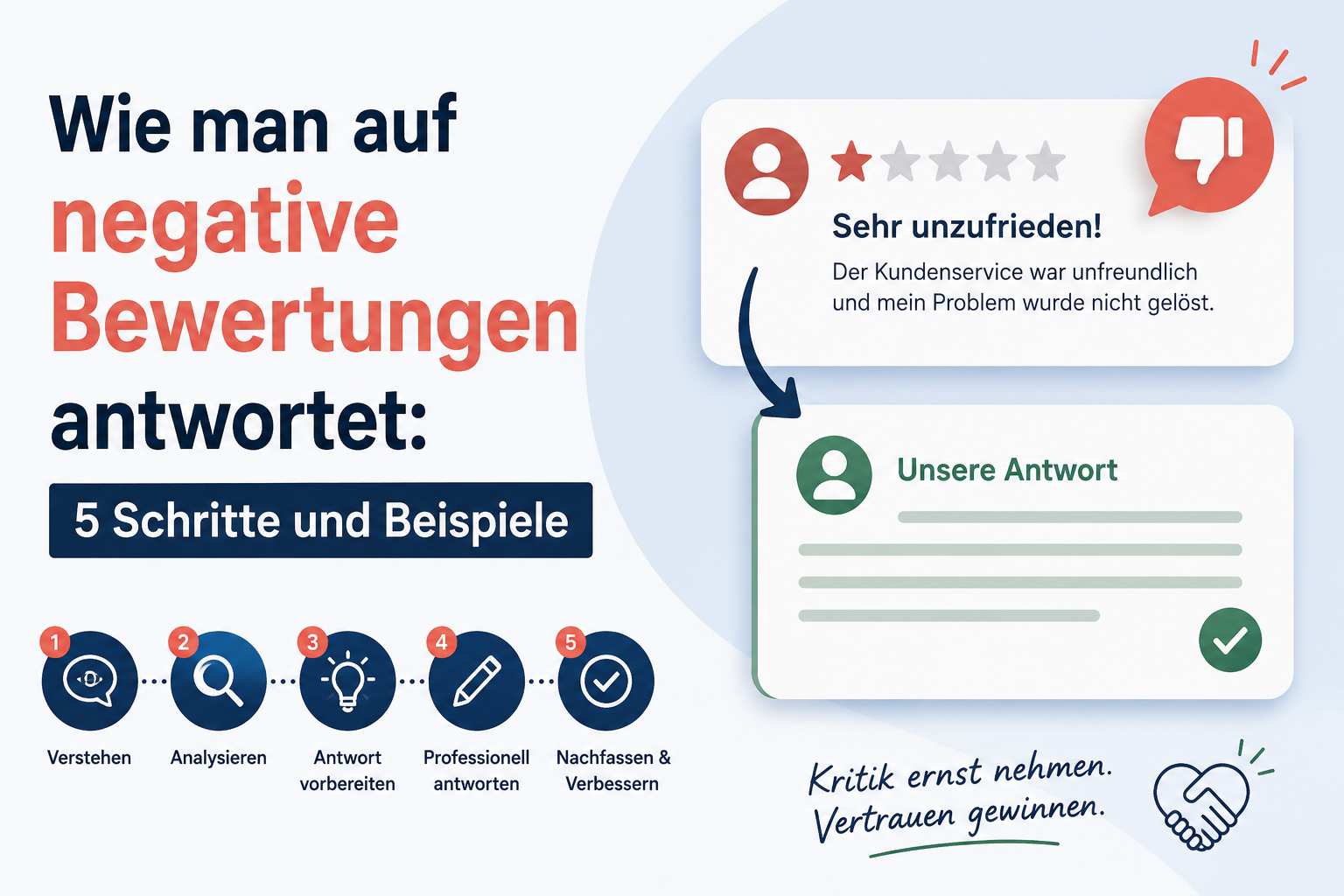
How to Respond to Negative Reviews: 5 Steps and Examples
A bad review hits almost every business sooner or later – and it can feel like a punch to the gut. However, negative reviews are not a reason to panic. On the contrary: how you respond often says more about your business to potential customers than the original complaint itself. A thoughtful, professional response can turn an unhappy guest into a loyal regular – and signals to all readers that you take responsibility. In this guide, we will show you in five clear steps how to confidently respond to negative reviews, and provide concrete phrasing examples for practical use.
Why Responding to Negative Reviews is So Important
Online reviews are one of the most important trust factors in the purchasing process today. Studies regularly show that the vast majority of consumers read reviews before buying a product or using a service. Many people pay attention not only to the star rating but also specifically to how a company handles criticism.
A professional response to a negative review thus has multiple effects: it gives the dissatisfied customer a chance to feel heard, it demonstrates your service culture to all other readers, and it can even improve your visibility in search engines, as active review management sends a positive signal. In contrast, those who remain silent or react defensively squander valuable trust. A single critical voice rarely causes significant damage – an unanswered or poorly answered criticism, however, can.
The 5 Steps for a Professional Response
Step 1: Stay Calm and Don't React Immediately
The first impulse after receiving an unjustified criticism is often to justify oneself or to retaliate. This is exactly what you should avoid. Read the review several times calmly, take a deep breath, and never respond in an emotional outburst. A public response remains permanently visible – an impulsive statement can cause more damage than the original review.
Take your time to objectively examine the criticism: Is the accusation justified? Is there a known issue? If possible, speak internally with the involved employees to reconstruct the incident. Ideally, respond within 24 to 48 hours – fast enough to show engagement but calm enough to formulate a thoughtful response.
Example: Instead of immediately writing "That's not true at all!", wait a night and check the facts. A calm, fact-based response will always be more convincing the next day than a heated defense.
Step 2: Thank and Show Understanding
Start your response with appreciation. Even critical feedback is an opportunity for improvement – and you should express that. Address the person by name if possible and show genuine understanding for their disappointment. This immediately diffuses the situation and signals that you take their concern seriously.
Avoid clichéd or generic standard phrases that sound like templates. Refer specifically to what the person experienced. Authenticity is crucial here.
Example: "Dear Ms. Müller, thank you for taking the time to share your feedback with us. We sincerely regret to hear that your visit did not meet your expectations."
Step 3: Take Responsibility and Apologize
If the fault lies with you, own up to it – openly and without excuses. A sincere apology costs nothing and is incredibly trust-building. Do not shift the blame onto employees, suppliers, or the customer themselves. As a company, take responsibility for the overall experience.
If the criticism is unjustified or factually incorrect, you can politely and factually correct the situation – but always respectfully and without embarrassing the customer. Avoid trying to be right. Your goal is not to win the argument but to build trust with all readers.
Example (justified criticism): "You are absolutely right – the waiting time that evening was far too long, and that does not meet our standards. We sincerely apologize for that."
Example (unjustified criticism): "We understand your frustration. However, after reviewing our records, it appears that the booking was for a different date. We would be happy to clarify this together – please feel free to contact us at any time."
Step 4: Offer a Concrete Solution
An apology alone is often not enough – show that you want to actively solve the problem. Offer a concrete remedy, a correction, or at least a clarifying conversation. This conveys to both the affected person and all readers that you take problems seriously and take action.
Try to move the detailed clarification out of the public eye. Offer a direct contact method – via email or phone – to avoid exchanging sensitive information publicly and to make the conversation more personal. This shows genuine commitment without airing the complaint in public.
Example: "We would like to make this right. Please write to us at service@yourcompany.com or call us at 0123 456789 – we will personally take care of it and find a solution."
Step 5: Show Improvement and Follow Up
Close your response with a look ahead: What are you doing to ensure that the mistake does not happen again? Show that you are learning from the feedback. If you have indeed found a solution after clarification, kindly ask the person to update their review – but never pressure them.
Document recurring points of criticism internally. If similar complaints accumulate, there is a structural problem that you should address. This way, review management becomes a real tool for quality improvement.
Example: "Your feedback is very helpful to us – we have already adjusted our processes for weekends and scheduled additional staff. We would be very happy to welcome you back soon and to prove you wrong."
Complete Example: Response to a 1-Star Review
The Review: "Very disappointed. I waited 40 minutes for my food, and in the end, it was cold. The staff seemed overwhelmed. Not acceptable."
The Response:
"Dear Mr. Schmidt, thank you for giving us your honest feedback – and we sincerely regret that your visit went this way. A waiting time of 40 minutes and cold food is in no way what we stand for. You are absolutely right that this is unacceptable. That evening, we had an exceptional staffing situation, which does not excuse your experience. We have since revised our staffing plans for busy evenings. We would very much like to make this right – please contact us at service@yourcompany.com. We hope you give us the chance to impress you next time. Best regards, your team from [Restaurant Name]"
This response encompasses all five steps: it remains calm and factual, expresses gratitude, takes responsibility, offers a solution, and shows concrete improvement – without appearing defensive or submissive.
Common Mistakes to Avoid
Just as important as the right approach is knowing typical pitfalls. Never ignore reviews – silence comes across as indifference. Never be defensive or aggressive, even if the criticism is unfair. Do not use generic copy-paste responses that sound obviously the same for every review. Never blame others and do not discuss sensitive details publicly. And do not attempt to counteract with fake positive reviews – this will quickly backfire and damage your credibility permanently.
Frequently Asked Questions (FAQ)
How quickly should I respond to a negative review?
Ideally within 24 to 48 hours. This is fast enough to show that you take feedback seriously and gives you time to check the facts and formulate a thoughtful response. Never react in the first emotional impulse.
Should I really respond to every negative review?
Yes. Every unanswered criticism appears to readers as disinterest. A response shows all potential customers that you take responsibility and care about your guests – regardless of whether the criticism is justified or not.
What should I do about an obviously unjustified or fake review?
Remain polite and correct the facts objectively without attacking the author. For clearly fake or offensive reviews that violate guidelines, you can also report them to the respective platform (e.g., Google) for review and removal.
Can I simply have a negative review deleted?
You cannot delete reviews yourself. However, if a review violates the platform's guidelines – for example, through insults, false claims, or obvious fakes – you can report it for review. Justified criticism, on the other hand, cannot be removed and should be constructively addressed.
How do I apologize without admitting legal liability?
Express regret about the experience without admitting to specific wrongdoing or liability. Phrases like "We are sorry that your experience did not meet your expectations" show empathy without being legally vulnerable. When in doubt, consult legal advice for sensitive phrasing.
Should I conduct the discussion publicly or privately?
Initially respond publicly to make empathy and willingness to solve visible to all readers. Move the specific clarification and any potential remedy to a private channel like email or phone. This protects sensitive information and makes the conversation more personal.
How do I respond when an employee is criticized personally?
Defend your team without attacking the customer. Thank them for the feedback, signal that you will clarify the incident internally, and do not publicly disclose any internal personnel details. As a company, take responsibility for the overall experience.
Can a well-answered negative review even bring advantages?
Absolutely. A professional, empathetic response shows potential customers your service culture and how you handle problems. Many people trust a company that responds confidently to criticism more than one with only perfect reviews – the latter often appears unbelievable.
Should I ask the customer to change their review?
Only if you have actually resolved the problem – and then kindly and without pressure. A phrase like "If we have met your expectations, we would appreciate an update to your review" is appropriate. Do not pressure or offer incentives, as this violates the guidelines of many platforms.
What should I do if the same criticism keeps repeating?
Recurring complaints are a valuable warning signal for a structural problem. Document the points of criticism internally, analyze the causes, and adjust your processes. This way, review management becomes a real tool for lasting quality improvement – and negative reviews will gradually decrease over time.
Conclusion
Negative reviews are not a threat but an opportunity. With the five steps – stay calm, thank and show understanding, take responsibility, offer a solution, and demonstrate improvement – you can turn criticism into trust. What matters is not that nothing ever goes wrong, but how confidently and humanely you handle it. Those who actively and professionally manage reviews strengthen their image in the long run, gain the trust of new customers, and turn complaints into valuable improvement impulses.
About the Author

Nicolas Sacotte
Nicolas is a trained business graduate with a focus on international marketing. He has been active in online marketing since 1998 and has a wealth of experience when it comes to visitor acquisition on the internet. He not only focuses on organic and paid channels but also helps renowned medium-sized companies and large corporations in the DACH region to advance brand building and reputation.
All Articles by Nicolas Sacotte